

The Secrets of the Federal Reserve by Eustace Mullins
Author: Eustace MullinsGenre: Non-Fiction Pages: 227Year: 1982Categories:Business & Economics History Non-fiction Politics & Current Affairs Tags:Banking Central Banking Economic History Economic Power Economics Eustace Mullins Federal Reserve Finance Financial System Government Investigative Nonfiction Monetary Policy Money Supply Political Critique Public Finance SummaryThe Secrets of the Federal Reserve examines the history, structure, and influence of the U.S. Federal Reserve System. Mullins argues that the institution exerts significant control over the economy, government policy, and financial systems, presenting his perspective on its operations and effects.Read Extended AbstractThe Secrets of the Federal Reserve by Eustace Mullins explores the origins, organization, and operations of the United States Federal Reserve System. The book presents Mullins’ interpretation of the institution’s historical development, focusing on the creation of central banking, the concentration of financial power, and the influence of private banking interests on national and international economics. Mullins discusses monetary policy, government debt, and the mechanisms through which the Federal Reserve interacts with commercial banks, financial markets, and political institutions. The work also examines the broader economic and social consequences of central banking, including its role in shaping economic cycles, inflation, and public finance. While written from a critical perspective, the book is frequently cited in studies of financial systems, monetary theory, and debates surrounding central banking policy.Related BooksEugenics by Irving FisherMeditations by Marcus AureliusOn the Latin Language by VarroTrotsky and The Jews Behind the Russian Revolution by a Former Russian Commisar
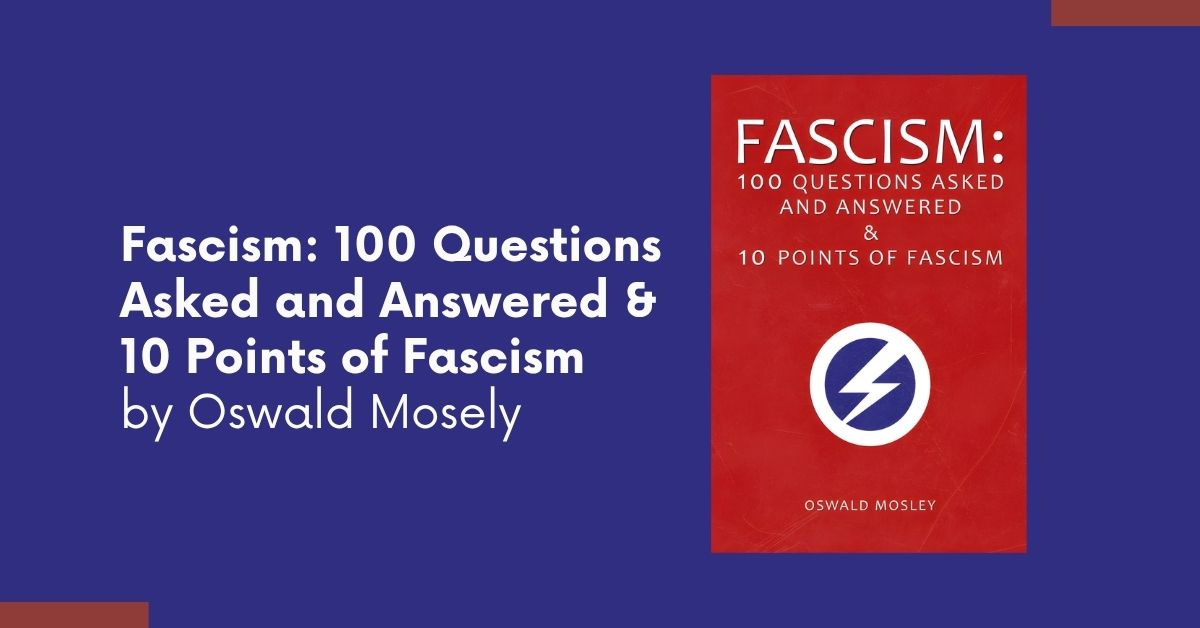
Fascism: 100 Questions Asked and Answered & 10 Points of Fascism by Oswald Mosely
Author: Oswald MoselyGenre: Non-Fiction Pages: 51Categories:Essays & Commentary Non-fiction Politics & Current Affairs Sociology Tags:20th Century Politics Controversial Literature Economic Policy Essay Collection Extremist Literature Fascism Governance Historical Study Nonfiction Oswald Mosley Policy Political Ideology Radical Politics Social Organization Sociopolitical Theory SummaryFascism: 100 Questions Asked and Answered addresses common inquiries about fascist ideology, providing Mosley’s explanations and justifications for its principles, structure, and goals. The Ten Points of Fascist Policy outlines the key political and social objectives of Mosley’s movement, summarizing the foundational ideas intended to guide governance, economy, and society.Read Extended AbstractThese works by Oswald Mosley provide a detailed exposition of his vision of fascist ideology and policy. Fascism: 100 Questions Asked and Answered systematically addresses common questions about fascism, explaining its principles, political organization, social objectives, and the rationale behind its economic and governmental structures. The text is structured as a series of responses designed to clarify the movement’s goals and ideological foundations for readers and potential supporters. The Ten Points of Fascist Policy distills Mosley’s political program into ten key objectives, outlining proposed strategies for governance, economic management, social organization, and national development. Both works aim to present a coherent framework for understanding the movement’s ideology, emphasizing the interaction of political, economic, and social principles within a fascist framework. While these texts were written from a partisan perspective, they are often studied in historical and political scholarship to understand the ideas, rhetoric, and strategies of 20th-century fascist movements.Related BooksEugenics by Irving FisherMeditations by Marcus AureliusOn the Latin Language by VarroTrotsky and The Jews Behind the Russian Revolution by a Former Russian Commisar

Siege by James Mason
Author: James MasonGenre: Non-Fiction Pages: 557Year: 2015Categories:History Non-fiction Politics & Current Affairs Sociology SummarySiege is a compilation of newsletters written between the 1980s and early 2000s by James Mason, a National Socialist and former member of the American Nazi Party. The book advocates for the violent overthrow of the U.S. government and the creation of a white ethnostate. Mason promotes the idea that conventional politics is futile and encourages leaderless resistance, terrorism, and lone-wolf violence as the only effective means of achieving revolutionary change.Read Extended AbstractSiege has become influential in neo-Nazi and accelerationist circles, including groups like Atomwaffen Division. It is widely considered a terrorist manual and has been condemned for promoting violent extremism and domestic terrorism. While it is an interesting read and thought provoking, Mason has also admitted to taking pictures of underage girls and dating "marriageable aged girls," using Mary's age of 14 from the Bible, without taking into consideration the average life span of mankind at that time. All of which he was arrested and convicted of in 1994 after taking a plea deal. [Reference minute 32:30 https://www.bitchute.com/video/SDCz7AL0jFnf ]Related BooksEugenics by Irving FisherMeditations by Marcus AureliusOn the Latin Language by VarroTrotsky and The Jews Behind the Russian Revolution by a Former Russian Commisar
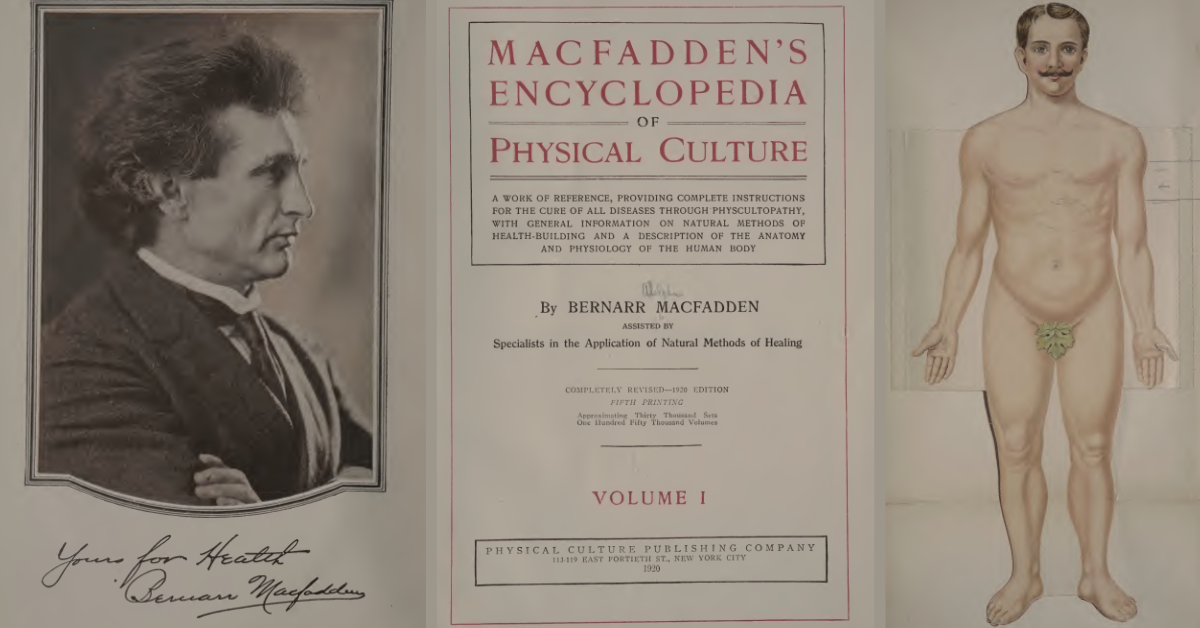
MacFadden’s Encyclopedia of Physical Culture by Bernarr MacFadden
Author: Bernarr MacFaddenGenre: Non-Fiction Pages: 656Year: 1920Categories:Health & Fitness Non-fiction SummaryMacFadden’s Encyclopedia of Physical Culture is a comprehensive guide to health, fitness, and exercise, covering topics such as strength training, nutrition, and physical development. The work provides practical instruction and advice aimed at improving physical well-being, athletic performance, and overall health.Read Extended AbstractMacFadden’s Encyclopedia of Physical Culture is a comprehensive reference work that covers the principles, practices, and benefits of physical fitness, health, and exercise. Compiled by Bernarr MacFadden, a prominent early 20th-century advocate of physical culture, the encyclopedia provides detailed guidance on strength training, gymnastics, calisthenics, and other forms of exercise designed to improve muscular development, flexibility, and overall physical health. The work also addresses nutrition, hygiene, and lifestyle practices that support physical well-being, emphasizing the interconnection between diet, exercise, and long-term health. With contributions on athletic training, bodybuilding, and preventive health measures, the encyclopedia serves both as a practical guide for individuals seeking to improve their fitness and as a historical document reflecting early modern approaches to physical culture. It combines instructional content with broader discussions of the philosophy of health and the promotion of a physically active lifestyle.Related BooksEugenics by Irving FisherMeditations by Marcus AureliusOn the Latin Language by VarroTrotsky and The Jews Behind the Russian Revolution by a Former Russian Commisar

Who were the Cimmerians, and where did they come from? by Anne Katrine Gade Kristensen
Author: Anne Katrine Gade KristensenGenre: Non-Fiction Pages: 147Year: 1988Categories:Anthropology Archaeology History Non-fiction Tags:Anatolia Ancient History Ancient Warfare Anthropology Archaeology Assyrians Cimmerians Early Civilizations Ethnography Eurasian Steppes Historical Migration Material Culture Nomadic Peoples Scythians Steppe Societies SummaryWho Were the Cimmerians, and Where Did They Come From? examines the origins, migrations, and historical impact of the Cimmerian people, an ancient nomadic group of the Eurasian steppes. The book analyzes archaeological evidence, historical records, and cultural context to explore their movements, interactions with neighboring civilizations, and legacy in early Eurasian history.Read Extended AbstractWho Were the Cimmerians, and Where Did They Come From? explores the history, origins, and movements of the Cimmerians, a nomadic people of the Eurasian steppes known from ancient records. The book examines archaeological findings, historical texts, and linguistic evidence to reconstruct the Cimmerians’ migration patterns, social structure, and interactions with neighboring civilizations such as the Assyrians, Scythians, and early Anatolian societies. The work addresses the cultural and military influence of the Cimmerians, including their role in regional conflicts and trade networks during the early first millennium BC. By analyzing their legacy and tracing the historical and archaeological evidence of their presence, the book situates the Cimmerians within the broader context of Eurasian nomadic societies and contributes to understanding the movement and impact of early steppe cultures.Related BooksEugenics by Irving FisherMeditations by Marcus AureliusOn the Latin Language by VarroTrotsky and The Jews Behind the Russian Revolution by a Former Russian Commisar

March of the Titans by Arthur Kemp
Author: Arthur KempPages: 1347Year: 2015Categories:History Non-fiction Tags:Academic Chronology Civilization Cultural Development Cultural History European History Historical Analysis Historical Survey Migration Nonfiction Politics Social Structures Sociopolitical History Warfare SummaryMarch of the Titans is a historical work that examines the rise and expansion of European civilizations from ancient times through the modern era. The book traces cultural, social, and political developments, analyzing how historical events, migration, and conflicts shaped the trajectory of European societies.Read Extended AbstractMarch of the Titans by Arthur Kemp is a historical survey that examines the development of European civilizations from antiquity through the modern era. The book explores the migration patterns, cultural achievements, political structures, and conflicts that influenced the formation and expansion of European societies. Kemp emphasizes the interactions between different groups, the evolution of social and economic systems, and the factors that shaped the identity and cohesion of European peoples over time. The work also addresses the impact of wars, territorial expansion, and cultural exchanges on European history, illustrating how internal and external forces contributed to the rise and fall of civilizations. While presenting a broad chronological narrative, the book aims to contextualize major events within long-term social, political, and cultural trends, offering readers an overview of European development across millennia. It serves as a reference for understanding historical patterns, societal transformations, and the factors that influenced the trajectory of European civilizations. Download