
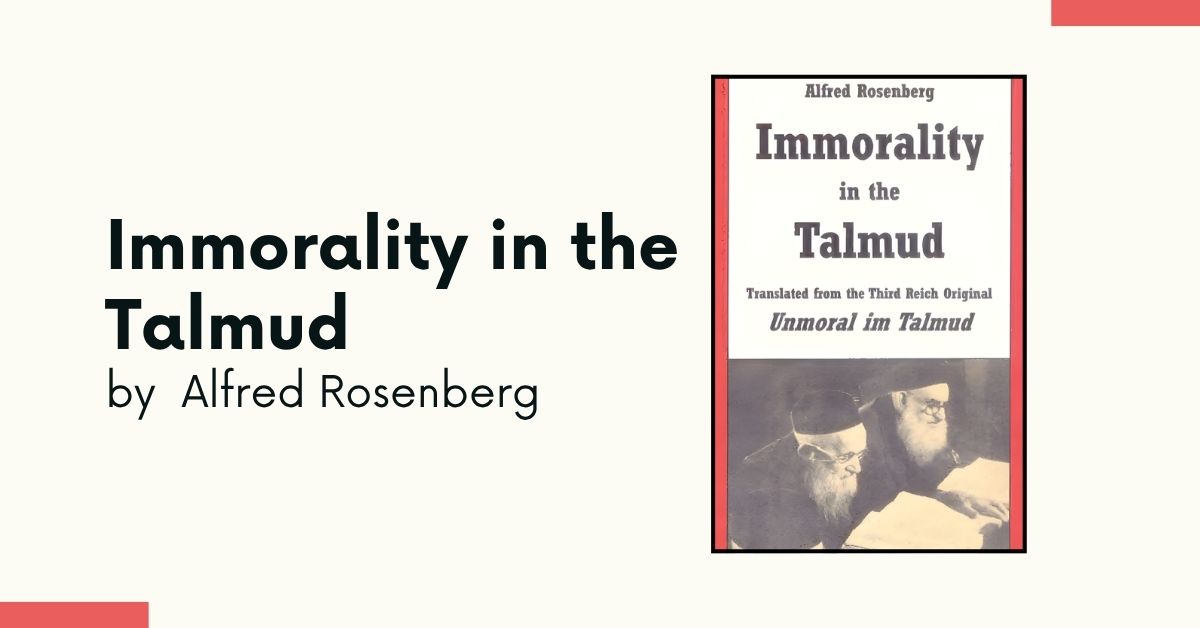
Immorality in the Talmud by Alfred Rosenberg
Author: Alfred RosenbergGenre: Non-Fiction Pages: 30Year: 2007Categories:History Non-fiction Religion Tags:Commentary Cultural Studies Ethical Interpretation Historical Context Immorality in the Talmud Intellectual History Nonfiction Polemical Literature Religious Discourse Religious Studies Religious Texts Rosenberg Scriptural Interpretation Talmud Textual Analysis SummaryImmorality in the Talmud compiles and interprets selected passages from the Talmud, presenting them through the author’s critical perspective. The work reflects a polemical approach to religious texts, shaped by the intellectual and ideological climate of its time.Read Extended AbstractImmorality in the Talmud by Rosenberg is a compilation and commentary that focuses on selected excerpts from the Talmud, accompanied by the author’s interpretations and conclusions. The book is structured around presenting passages and offering commentary intended to evaluate their ethical and social meaning. Rather than functioning as a comprehensive or contextual study of the Talmud, the work reflects a selective and interpretive approach characteristic of polemical religious literature. It is situated within a broader historical context in which religious texts were often debated, critiqued, or contested across cultural and ideological lines. In contemporary contexts, the book is primarily approached as a historical example of religious polemics, illustrating how interpretation, selection, and framing can shape the understanding of complex religious traditions.Related BooksEugenics by Irving FisherMeditations by Marcus AureliusOn the Latin Language by VarroTrotsky and The Jews Behind the Russian Revolution by a Former Russian Commisar

The Jew as Criminal by J. Keller and Hanns Andersen
Author: J. Keller and Hanns AndersenGenre: Non-Fiction Pages: 213Year: 2002Categories:Criminology History Non-fiction Sociology Tags:Criminal Behavior Criminology Cultural Studies Early 20th Century Economic Conditions Historical Analysis History of Science Keller and Andersen Legal Systems Nonfiction Social Research Social Theory Sociology The Jew as Criminal Urbanization SummaryThe Jew as Criminal is a polemical work that attempts to examine crime through the lens of ethnic and social identity. The authors present arguments linking patterns of criminal behavior to broader social and historical conditions.Read Extended AbstractThe Jew as Criminal by Keller and Andersen is a work situated within early 20th-century debates on criminology, sociology, and group identity. The authors attempt to analyze crime using statistical claims, historical references, and contemporary theories, framing their discussion around the relationship between social conditions, environment, and patterns of behavior. The text reflects a period when criminology often incorporated broad generalizations and group-based interpretations, drawing on methodologies and assumptions that are now widely questioned. It engages with themes such as urbanization, economic conditions, and legal systems. Today, the book is primarily examined in the context of the history of criminology and social thought, offering insight into how earlier frameworks approached questions of crime, identity, and society.Related BooksEugenics by Irving FisherMeditations by Marcus AureliusOn the Latin Language by VarroTrotsky and The Jews Behind the Russian Revolution by a Former Russian Commisar

Race by John R. Baker
Author: John R. BakerGenre: Non-Fiction Pages: 323Year: 1981Categories:Anthropology Biology History Non-fiction Sociology Tags:Academic Anthropology Biology Classification Cultural Interpretation Evolution Genetics Human Biology Human Variation John R. Baker Nonfiction Physical Anthropology Race Scientific History Social Theory SummaryRace by John R. Baker examines the concept of human racial classification from a biological and anthropological perspective. The book analyzes physical variation among human populations and discusses how these differences have been interpreted within scientific and social frameworks.Read Extended AbstractRace by John R. Baker is a work of physical anthropology that explores human variation and the classification of populations based on biological characteristics. Baker surveys traits such as skin color, hair type, and cranial features, using these to discuss historical approaches to categorizing human groups. The book reflects mid-20th-century scientific perspectives on race, drawing on comparative anatomy, genetics, and evolutionary theory. The work also addresses how racial classifications have been used in broader social and historical contexts, examining the relationship between biology and cultural interpretation. While influential in its time, the book represents an earlier stage of anthropological thought, and many of its assumptions and frameworks are now debated or reconsidered in modern scholarship. Related BooksEugenics by Irving FisherMeditations by Marcus AureliusOn the Latin Language by VarroTrotsky and The Jews Behind the Russian Revolution by a Former Russian Commisar

The Anti-Humans: Student Re-Education in Romanian Prisons by Dumitru Bacu
Author: Dumitru BacuGenre: Non-Fiction Pages: 119Categories:History Non-fiction Politics & Current Affairs Sociology Tags:1950s Eastern Europe Communist Romania Dumitru Bacu Gherla Prison Historical Account Human Rights Ideological Persecution Memoir Nonfiction Pitesti Prison Political Repression Prison Testimony Re‑Education Torture Totalitarianism SummaryThe Anti‑Humans: Student Re‑Education in Romanian Prisons is a firsthand account of the psychological and physical re‑education program conducted in Romanian prisons after the Communist takeover. The book documents the methods of imprisonment, torture, and forced ideological conformity experienced by university students and other political prisoners.Read Extended AbstractThe Anti‑Humans: Student Re‑Education in Romanian Prisons by Dumitru Bacu is a historical testimony about the brutal re‑education experiments carried out in Romanian prisons such as Pitesti and Gherla in the early 1950s. Bacu, himself imprisoned, investigates and describes the systematic use of torture, psychological coercion, and dehumanization designed to force inmates to renounce deeply held beliefs and adopt Communist ideology. The book provides detailed accounts of the conditions endured by prisoners, particularly young university students who were targeted as a group perceived by the regime as intellectually and socially influential. It explores the mechanisms of repression, the breakdown of personal identity through “re‑education,” and the extreme measures used to extract confessions and enforce ideological compliance. Bacu’s narrative combines personal experience, eyewitness testimony, and historical context to illustrate the human cost of political persecution under totalitarian systems. The work has value as a historical document that sheds light on one of the most severe episodes of political imprisonment in Eastern Europe during the early Cold War, and it serves as a reminder of the dangers of systematic abuse of power against individuals based on their beliefs.Related BooksEugenics by Irving FisherMeditations by Marcus AureliusOn the Latin Language by VarroTrotsky and The Jews Behind the Russian Revolution by a Former Russian Commisar
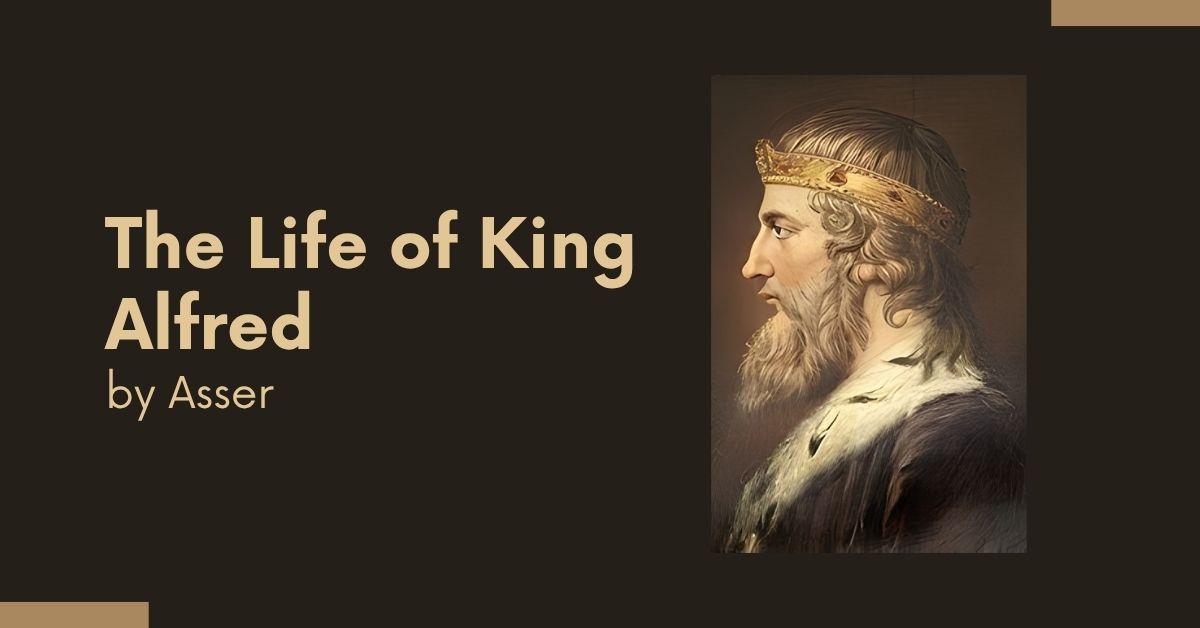
The Life of King Alfred by Asser
Author: AsserGenre: Non-Fiction Pages: 104Year: 1906Categories:Biography & Memoir History Military Non-fiction Religion Tags:Alfred the Great Anglo-Saxon England Asser Biography Christian Influence Early England Education Reform Kingship Medieval History Military History Old English Political History Primary Source Viking Invasions Wessex SummaryThe Life of King Alfred by Asser chronicles the reign of Alfred the Great, highlighting his military struggles against Viking invasions and his efforts to strengthen his kingdom. The work also portrays Alfred’s dedication to learning, law, and religious reform, presenting him as both a capable ruler and a patron of education.Read Extended AbstractThe Life of King Alfred by Asser is a contemporary biographical account of Alfred the Great, offering insight into his reign during a period of significant political and military upheaval in early medieval England. Written by a close associate and scholar at Alfred’s court, the text combines historical narrative with personal observation, detailing Alfred’s lineage, early life, and accession to the throne of Wessex. The work emphasizes Alfred’s leadership during the Viking invasions, particularly his strategic resilience and efforts to defend and consolidate his kingdom. In addition to military achievements, Asser highlights Alfred’s commitment to education, legal reform, and religious life, including his promotion of learning and translation of important texts into Old English. The biography reflects both historical events and the author’s admiration for Alfred, presenting a portrayal that blends political history with moral and intellectual characterization, making it a key primary source for understanding Anglo-Saxon England and Alfred’s legacy.Related BooksEugenics by Irving FisherMeditations by Marcus AureliusOn the Latin Language by VarroTrotsky and The Jews Behind the Russian Revolution by a Former Russian Commisar

The Farmers and the Tariff: An Appeal for Social Justice to Aryans by Junius Aryan
Author: Junius AryanGenre: Non-Fiction Pages: 22Year: 1913Categories:Business & Economics History Non-fiction Politics & Current Affairs Tags:Agricultural Economics Aryans Economic History Economic Policy Farmers and the Tariff Historical Analysis Nonfiction Political Ideology Rural Communities Social Justice Sociopolitical Study Tariffs Trade SummaryThe Farmers and the Tariff addresses economic issues affecting farmers, arguing that trade policies and tariffs have disproportionate impacts on agricultural communities. The book frames these economic discussions within a racialized perspective, appealing specifically to Aryans.Read Extended AbstractThe Farmers and the Tariff: An Appeal for Social Justice to Aryans explores the effects of tariff policies on agriculture and rural economies. The author argues that government-imposed trade restrictions and economic regulations disadvantage farmers, limiting their economic opportunities and profitability. The work presents a perspective that links economic policy with social and racial identity, emphasizing the need for solidarity and advocacy among Aryans. While the book is written from a specific ideological standpoint, it provides historical insight into how economic arguments were framed within racialized discourse, reflecting broader trends in political and social thought of the period.Related BooksEugenics by Irving FisherMeditations by Marcus AureliusOn the Latin Language by VarroTrotsky and The Jews Behind the Russian Revolution by a Former Russian Commisar