
Categories:
Business & Economics History Non-fiction Politics & Current AffairsSummary
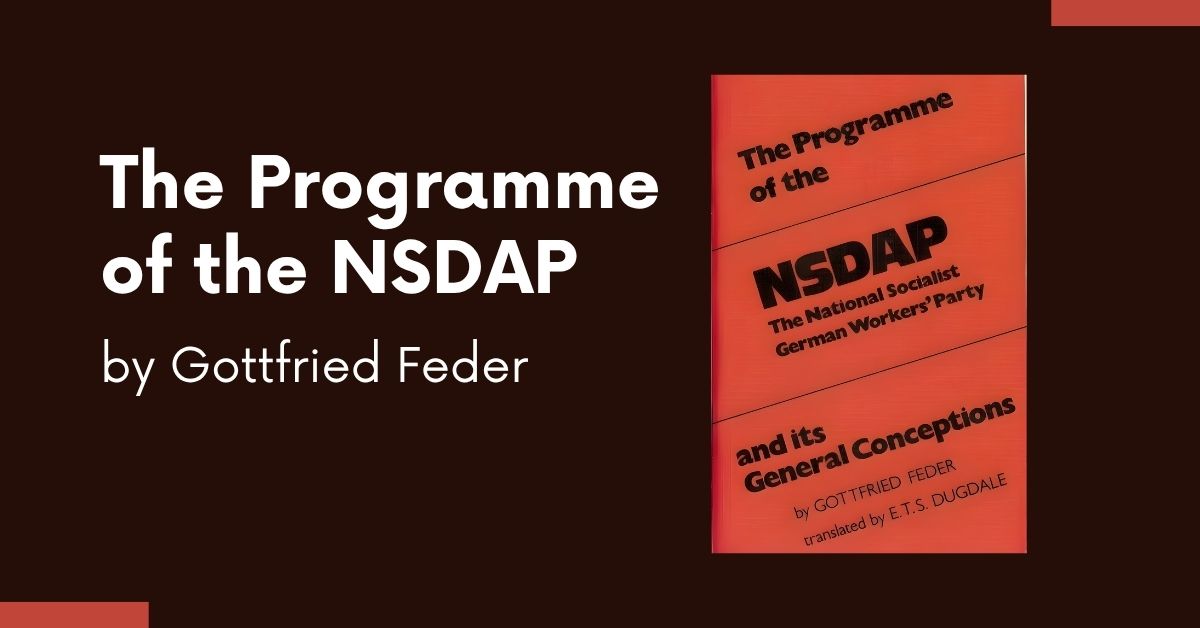
The Programme of the NSDAP and Its General Conceptions outlines the ideological and political principles of the National Socialist German Workers’ Party as formulated in the early 1930s. It presents the party’s positions on nationalism, economic reform, social welfare, and cultural policy, offering insight into the worldview and policy goals that guided the NSDAP prior to its rise to power.
Read Extended Abstract
The Programme of the NSDAP and Its General Conceptions is a 1932 English‑language edition of the official political manifesto of the National Socialist German Workers’ Party (NSDAP), prepared by economist and early party theoretician Gottfried Feder. This document expands upon the party’s core principles and ideological foundations, outlining its positions on political, economic, social, cultural, and military policy as it stood in the early 1930s. The work begins by situating National Socialism within the context of post‑World War I Germany, critiquing existing political and economic systems — including liberal capitalism, Marxism, and traditional party politics — as sources of national chaos and decline. It then articulates a comprehensive worldview that frames the nation as an organic community (“Volksgemeinschaft”) in which the general welfare takes precedence over individual interests. The programme emphasizes nationalism, racial definitions of citizenship, exclusionary immigration policy, and state regulation of economic life. Feder’s outline includes detailed sections on agricultural policy, credit and finance reform, nationalization of certain sectors, the role of the state in providing for citizens’ welfare, and cultural direction. It calls for a restructuring of the financial system to “break the thraldom of interest,” state intervention in economic production, and measures aimed at social security for workers and the elderly. The manifesto also addresses cultural aims, educational priorities, and military affairs, reflecting the broad scope of the NSDAP’s political agenda prior to its seizure of power. As a historical document, the programme reveals the party’s ideological self‑presentation and its attempt to articulate a unified conception of society, economics, and national identity. It is studied by scholars of 20th‑century political history for insight into how National Socialist ideology was formally expressed and justified in the period leading up to the NSDAP’s ascension in Germany.