
Categories:
Business & Economics History Non-fiction Politics & Current AffairsSummary
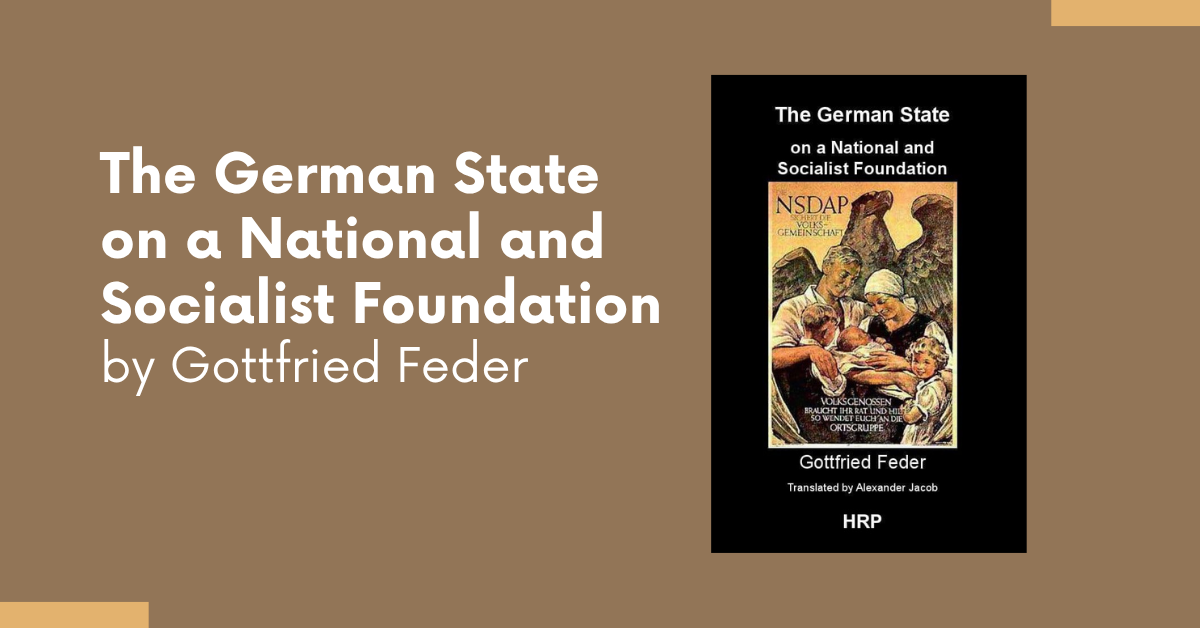
Written by an economist and early NSDAP member, Gottfried Feder outlines the ideological and economic vision for the new German State based on nationalist and socialist principles. He advocates for the eradication of the interest slavery debt system and replaces it with an economic system that prioritizes the collective good over an individual capitalist profit. It is the foundational text for the National Socialist’s economic system and highlights state control over key industries, land reform, and the exclusion of foreign financial influence.
Read Extended Abstract
The German State on a National and Socialist Foundation is a nonfiction political and economic work originally published in 1923 by German economist Gottfried Feder, a key early figure in the development of National Socialist economic thought. The book outlines Feder’s vision for restructuring the German state and economy on what he describes as “national and socialist” principles, emphasizing a radical critique of debt‑finance capitalism and advocating fundamental reforms in banking, credit, and state economic policy that he believed would free the nation from what he saw as exploitative financial systems. Feder presents a theoretical framework in which the state assumes responsibility for issuing credit, regulates economic activity in the name of national welfare, and seeks to align economic structures with notions of social justice as defined within the context of his time and ideological perspective. His arguments link economic reform with broader political and cultural objectives aimed at strengthening the German nation after the disruptions of World War I and the economic instability of the early 1920s. The text also reflects the early National Socialist critique of the Weimar Republic’s economic order, including opposition to international finance and what Feder characterizes as “parasitic” economic structures, and it situates these ideas within an ideological framework that later influenced the economic policies of the National Socialist Party (NSDAP). Although Feder’s prominence within the movement waned as other leaders and industrial interests took precedence, his proposals contributed to the intellectual development of National Socialist economic thought prior to the party’s rise to power. As a historical document, the book provides insight into the ideological foundations and economic aspirations of early National Socialist theorists. It explores themes such as national sovereignty, economic reform, state control of credit, and the relationship between politics and economics in post‑World War I Germany, and is primarily studied today in the context of 20th‑century political history, economic ideology, and the origins of National Socialism.